Important Notice: The FitFam THC Inhaler is not a medical device and is not marketed, labeled, or sold for the diagnosis, treatment, cure, mitigation, or prevention of any disease or medical condition. It is a consumable hemp product sold over the counter to adults 21 years of age or older with valid government-issued identification, in full compliance with Texas Health and Safety Code Chapter 443.
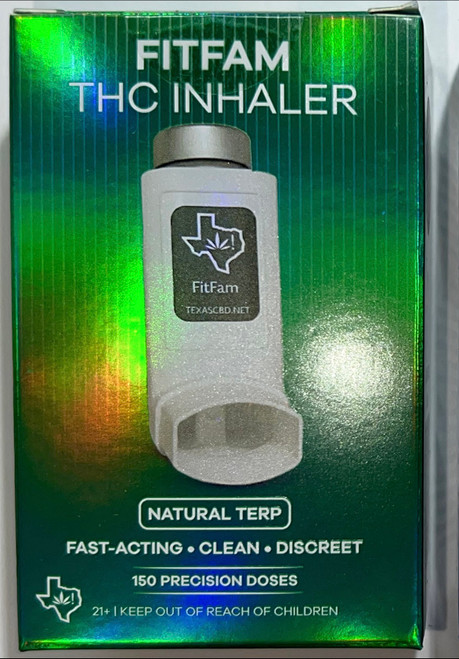
FITFAM THC INHALER
150 Metered Actuations | Mechanical Pressurized Delivery
The FitFam THC Inhaler is a mechanically actuated, pressurized metered-dose hemp inhalation product designed to deliver a consistent quantity of hemp-derived Delta-9 THC with each actuation.
It contains:
- No battery
- No heating element
- No electronic circuitry
- No coil
- No combustion
The product uses a pressurized HFA-134a propellant system to deliver the formulation mechanically through a metering valve.
PRODUCT DETAILS
Capacity: Approximately 150 metered actuations
Available varieties:
- Natural Terp
- Cool Mint
Delivery system: Mechanical pressurized metered-dose aerosol
Propellant: HFA-134a
Cannabinoid source: Hemp-derived Delta-9 THC
Age restriction: For adults 21 years of age or older only
CURRENT LABORATORY TESTING
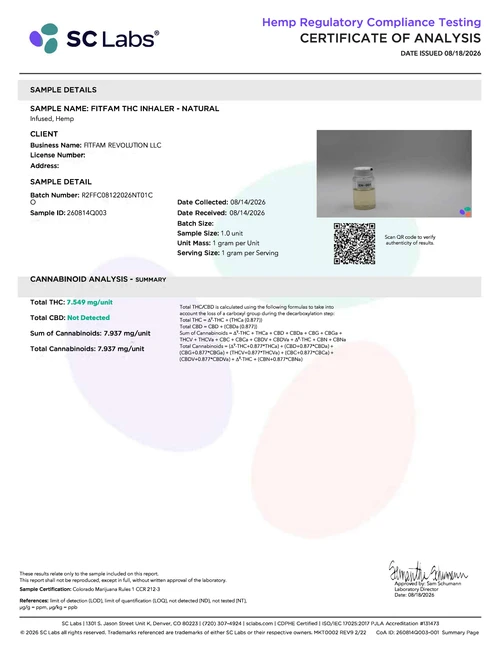
Independent cannabinoid testing was performed by SC Labs using HPLC-DAD methodology.
Natural Terp
SC Labs Sample: 260814Q003
Delta-9 THC in analytical sample:
7.549 mg/g
0.7549%
THCA: Not Detected
Delta-8 THC: Not Detected
Cool Mint
SC Labs Sample: 260814Q004
Delta-9 THC in analytical sample:
7.639 mg/g
0.7639%
THCA: Not Detected
Delta-8 THC: Not Detected
These laboratory percentages represent the cannabinoid concentration of the non-propellant formulation submitted for analytical testing.
The SC Labs COAs identify a 1.0-gram analytical sample and do not include HFA-134a propellant as part of the reported analytical sample mass.
FINISHED PRODUCT FORMULATION
The finished FitFam THC Inhaler is a pressurized formulation consisting of both the cannabinoid-containing liquid formulation and HFA-134a propellant.
Manufacturer formulation records document approximately:
6.50 grams HFA-134a propellant
plus approximately:
3.64 to 3.66 grams non-propellant formulation
for a total finished formulation of approximately:
10.14 to 10.16 grams per canister
HFA-134a therefore represents approximately 64% of the total finished formulation by mass.
THC Potency & pMDI Formulation Explained
The FitFam THC Inhaler is a pressurized metered-dose inhaler (pMDI). Because this product contains a volatile HFA-134a propellant, the percentage reported on a cannabinoid laboratory assay should not be confused with the percentage of Delta-9 THC in the complete finished pressurized formulation.
What the SC Labs COAs Measure
SC Labs analyzed the cannabinoid-containing, non-propellant formulation and reported the following results:
Natural Terp
Delta-9 THC: 7.549 mg/g
Reported analytical concentration: 0.7549%
THCA: Not Detected
Delta-8 THC: Not Detected
Cool Mint
Delta-9 THC: 7.639 mg/g
Reported analytical concentration: 0.7639%
THCA: Not Detected
Delta-8 THC: Not Detected
Each SC Labs COA identifies a 1.0 gram analytical sample. These percentages describe the concentration of Delta-9 THC in the material analyzed by the laboratory. They do not, by themselves, state the percentage of Delta-9 THC in the complete HFA-containing finished inhaler.
Why the Finished Product Is Different From the Analytical Sample
The finished FitFam THC Inhaler contains both:
1. The cannabinoid-containing liquid formulation, and
2. HFA-134a propellant
Manufacturer formulation records show approximately:
6.50 g HFA-134a propellant
3.64–3.66 g non-propellant formulation
10.14–10.16 g total finished formulation
HFA-134a therefore represents approximately 64% of the mass of the complete finished formulation.
HFA-134a is a volatile propellant. It is not represented in an ordinary cannabinoid HPLC sample in the same manner as the non-propellant liquid formulation. As a result, the raw laboratory percentage reflects the concentration of the analytical material tested rather than automatically establishing the percentage of the complete pressurized formulation.
Calculating Delta-9 THC From the Actual SC Labs Results
The SC Labs results can be combined with the manufacturer-documented formulation quantities to estimate the total Delta-9 THC contained in the finished formulation.
Natural Terp
SC Labs measured:
7.549 mg Delta-9 THC per gram
The manufacturer documents approximately:
3.66 g of non-propellant formulation
Therefore:
7.549 mg/g × 3.66 g = approximately 27.63 mg Delta-9 THC
The complete finished formulation is approximately:
10.16 g = 10,160 mg
Therefore:
27.63 mg ÷ 10,160 mg × 100 = approximately 0.272% Delta-9 THC
Cool Mint
SC Labs measured:
7.639 mg Delta-9 THC per gram
The manufacturer documents approximately:
3.64 g of non-propellant formulation
Therefore:
7.639 mg/g × 3.64 g = approximately 27.81 mg Delta-9 THC
The complete finished formulation is approximately:
10.14 g = 10,140 mg
Therefore:
27.81 mg ÷ 10,140 mg × 100 = approximately 0.274% Delta-9 THC
Manufacturer Formulation Calculation
The manufacturer’s formulation records provide an additional calculation based on the amount and potency of the hemp-derived Delta-9 ingredient used during production.
Approximately:
0.031 g of hemp-derived Delta-9 material at 94% potency
is used per canister.
This corresponds to approximately:
29.14 mg of actual Delta-9 THC
When expressed relative to approximately 10.14–10.16 g of total finished formulation, the nominal finished-formulation concentration is approximately:
0.287% Delta-9 THC
Accordingly, both the laboratory-assay calculation and the manufacturer’s nominal formulation calculation place the complete finished formulation below 0.300% Delta-9 THC, when HFA-134a is included as a constituent of the finished pressurized formulation.
Why the Raw COA Percentage Is Not the Same as the Finished-Product Percentage
The distinction is one of denominator.
The SC Labs COAs answer:
“How much Delta-9 THC is present per gram of the non-propellant analytical material tested?”
The finished-product calculation answers:
“How much Delta-9 THC is present relative to the complete pressurized formulation contained in the finished inhaler?”
Those are different measurements.
For example, treating the SC Labs result of approximately 0.76% as though every gram of the finished inhaler had the same cannabinoid concentration would implicitly treat the HFA-134a portion of the product as though it contained THC at the same concentration as the cannabinoid-bearing liquid formulation.
The manufacturer’s formulation records show that this is not the case. Approximately 64% of the finished formulation mass consists of HFA-134a propellant.
Historical Laboratory Testing Supports This Distinction
A prior Kaycha Labs Certificate of Analysis for the same product format identified the retail product as a 14 g inhaler, while the analytical extraction weight was approximately 1.0316 g.
Kaycha reported a Delta-9 THC analytical concentration of 0.5730%, but separately stated in its laboratory comments:
“THIS ATOMIZER/INHALER (pMDI) HAS BEEN FORMULATED TO DELIVER <0.3% TETRAHYDROCANNABINOL (THC) IN ACCORDANCE WITH THE 2018 AGRICULTURAL IMPROVEMENT ACT.”
That historical report reflects the same distinction between the cannabinoid concentration of the material subjected to laboratory analysis and the characterization of the complete pMDI formulation.
The prior Kaycha cannabinoid panel also reported Delta-8 THC, Delta-10 THC, THCA, THC-O acetate, and HHC as Not Detected.
Technical Reference to Conventional pMDI Standards
The FitFam THC Inhaler is marketed as a consumable hemp product and is not represented as a pharmaceutical drug or medical device.
References to conventional pressurized metered-dose inhaler standards are provided solely as technical precedent for understanding how pressurized aerosol formulations are characterized.
pMDI technology has an established technical framework involving:
formulation composition, metered dose, delivered dose per actuation, propellant content, and total fill weight.
Because current Texas hemp regulations do not appear to provide a specific analytical methodology addressing the treatment of HFA propellant in a hemp-derived pMDI, conventional pMDI principles provide relevant technical context for understanding the relationship between the laboratory assay and the complete finished pressurized formulation.
Use of those technical principles does not constitute or imply a claim that this product is a medical device or pharmaceutical product.
Regulatory Note
Texas law establishes a maximum allowable Delta-9 THC concentration for consumable hemp products. Current Texas regulations do not appear to prescribe a specific pMDI testing methodology explaining whether HFA-134a must be included or excluded when calculating the product-level percentage of a finished pressurized hemp inhaler.
For that reason, the percentages shown above distinguish clearly between:
Laboratory analytical concentration:
Natural Terp — 0.7549%
Cool Mint — 0.7639%
and
Calculated complete finished-formulation concentration using the actual SC Labs assay and manufacturer formulation data:
Natural Terp — approximately 0.272%
Cool Mint — approximately 0.274%
Manufacturer nominal finished-formulation calculation:
Approximately 0.287% Delta-9 THC
These calculations are provided transparently so consumers, laboratories, and regulators can distinguish the potency of the non-propellant analytical sample from the cannabinoid concentration calculated for the complete pressurized formulation.
Important Disclaimer
The calculations above are based on laboratory cannabinoid results and manufacturer-provided formulation records. They are intended to explain the composition and analytical characteristics of the product.
Nothing on this page should be interpreted as medical advice or as a representation that the product is intended to diagnose, treat, cure, mitigate, or prevent any disease or medical condition.
The FitFam THC Inhaler is intended for adults 21 years of age or older.
IMPORTANT TECHNICAL NOTE
Texas law establishes a maximum Delta-9 THC concentration of 0.3% on a dry-weight basis for consumable hemp products.
Current Texas hemp rules do not appear to provide a specific analytical methodology for determining THC concentration in a pressurized metered-dose hemp product containing a volatile HFA propellant.
For this reason, established pressurized metered-dose inhaler principles are referenced as relevant technical guidance for understanding formulation composition, metered delivery, and per-actuation performance.
These references are made solely because pMDI technology provides the closest established technical framework for analyzing this type of pressurized delivery system.
They are not intended to represent or imply that the FitFam THC Inhaler is a pharmaceutical drug or medical device.
The FitFam THC Inhaler is marketed and sold as a consumable hemp product for adult use.
HOW THE DELIVERY SYSTEM WORKS
The finished canister contains both the hemp-derived formulation and HFA-134a propellant under pressure.
When the inhaler is actuated:
- A mechanical metering valve releases a predetermined amount of the pressurized formulation.
- The HFA-134a propellant rapidly expands and volatilizes after leaving the actuator.
- The remaining formulation is dispersed as a fine aerosol.
No battery, heating coil, combustion process, or electronic vaporization system is used.
CERTIFICATES OF ANALYSIS
Batch-specific Certificates of Analysis are available for review.
Natural Terp
SC Labs Sample 260814Q003
Batch R2FFC08122026NT01CO
Cool Mint
SC Labs Sample 260814Q004
Batch R2FFC08122026CM02CO
REQUIRED CONSUMER WARNINGS
Keep out of reach of children.
Product may contain tetrahydrocannabinol (THC) and can cause a user to fail a drug test.
All THCs have psychoactive properties.
Pregnant or nursing women should consult a healthcare provider before use.
This product has not been evaluated by the FDA.
For adults 21 years of age or older only.
Do not drive or operate machinery after consuming THC.
FDA AND MEDICAL DISCLAIMER
This product is not intended to diagnose, treat, cure, mitigate, or prevent any disease or medical condition.
Nothing on this page should be interpreted as medical advice.
References to pressurized metered-dose inhaler technology, HFA-134a, laboratory methods, or pharmaceutical technical standards are provided solely to describe the engineering and analytical characteristics of the product and do not constitute a medical claim.
Texas Hemp Law: Why the FitFam THC Inhaler Falls Outside the Recent Prohibitions
Texas has adopted several new restrictions affecting intoxicating hemp products, including restrictions on cannabinoid e-cigarettes, synthetic or prohibited tetrahydrocannabinols, and products exceeding the legal Delta-9 THC concentration limit.
The FitFam THC Inhaler was designed around a different product architecture: a mechanically actuated pressurized metered-dose inhaler (pMDI) using hemp-derived Delta-9 THC and HFA-134a propellant.
Based on the definitions contained in current Texas law and the available laboratory and formulation records, the principal recent restrictions address product characteristics that are not present in the FitFam inhaler.
1. Texas Ban on Certain Cannabinoid E-Cigarette Products
Texas Senate Bill 2024 became effective September 1, 2025. The law expanded restrictions applicable to certain cannabinoid-containing e-cigarette products.
The statutory definition of an e-cigarette centers on a device that uses a mechanical heating element, battery, or electronic circuit to deliver material to the user.
The FitFam THC Inhaler does not operate in this manner.
It contains:
- No battery
- No electronic circuit
- No heating element
- No heating coil
- No combustion
- No electrically generated vapor
Instead, the product uses a pressurized canister, HFA-134a propellant, and a mechanical metering valve to release a predetermined quantity of formulation.
The distinction is important. A mechanical metering valve is not a mechanical heating element.
The FitFam pMDI does not heat cannabinoid material in order to produce vapor. The formulation is expelled by pressure and forms an aerosol as the propellant expands.
Accordingly, based on the statutory characteristics defining an e-cigarette, FitFam’s position is that its mechanically actuated, non-heated pMDI does not fall within the type of electronic/heated product regulated by Texas’s cannabinoid e-cigarette prohibition.
This conclusion concerns the product’s mechanical architecture and should not be interpreted as a statement that inhalable hemp products are exempt from Texas hemp testing, packaging, labeling, age, or other applicable requirements.
2. Delta-8 and Other Prohibited Tetrahydrocannabinols
Texas reinstated its controlled-substance treatment of certain tetrahydrocannabinols following the Texas Supreme Court’s 2026 decision. DSHS states that the relevant clarification became effective July 31, 2026.
The FitFam THC Inhaler is not formulated as a Delta-8 product.
The current SC Labs Certificates of Analysis report:
Delta-8 THC: Not Detected
THCA: Not Detected
for both currently tested formulations.
Historical full-spectrum cannabinoid testing by Kaycha Labs provides additional information regarding the product’s cannabinoid profile. That testing reported the following as Not Detected:
Delta-8 THC
Delta-10 THC
THCA
THC-O acetate
9(R/S)-HHC
THC inhaler COA.pdf
The cannabinoid ingredient intentionally used in the product is hemp-derived Delta-9 THC.
Accordingly, the FitFam inhaler is not dependent on Delta-8, Delta-10, THC-O, HHC, THCA, or similar alternative cannabinoids to create its cannabinoid content.
The current SC Labs panels are narrower than the historical Kaycha panel, so the company does not represent that those two newer reports independently tested for every conceivable synthetic cannabinoid. Rather, the formulation records and historical broader cannabinoid testing provide the additional product context.
3. Texas’s 0.3% Delta-9 THC Limit
Texas Health and Safety Code Chapter 443 prohibits the retail sale of a consumable hemp product when its Delta-9 THC concentration exceeds 0.3%. Current DSHS rules also require testing for Delta-9 THC, total Delta-9 THC, and total THC, including the applicable 0.3% dry-weight requirement.
The FitFam inhaler presents an unusual analytical issue because it is a pressurized HFA-containing formulation.
The current SC Labs reports show the concentration of Delta-9 THC in the material submitted for cannabinoid analysis:
Natural Terp:
7.549 mg/g = 0.7549%
Cool Mint:
7.639 mg/g = 0.7639%
These figures describe the cannabinoid concentration of the analytical material tested. They should not automatically be treated as the concentration of the complete finished pressurized formulation without considering the composition of the finished pMDI.
Manufacturer formulation records show that the finished product contains approximately:
6.50 grams HFA-134a propellant
plus approximately:
3.64–3.66 grams non-propellant formulation
for approximately:
10.14–10.16 grams total finished formulation
HFA-134a therefore represents approximately 64% of the complete formulation by mass.
When the actual SC Labs assay results are applied to the documented non-propellant formulation and the resulting Delta-9 THC mass is expressed relative to the complete HFA-containing formulation, the calculations are approximately:
Natural Terp: 0.272% Delta-9 THC
Cool Mint: 0.274% Delta-9 THC
The manufacturer’s nominal formulation calculation independently produces approximately:
0.287% Delta-9 THC
All three calculations are below 0.300% when the complete pressurized formulation is used as the product-level denominator.
4. Why the SC Labs Percentage and Finished-Product Percentage Are Different
This difference is not caused by changing the laboratory result.
The SC Labs results remain exactly what the laboratory reported:
0.7549% and 0.7639% Delta-9 THC in the analytical samples.
The issue is the denominator used when characterizing the complete finished pMDI.
Approximately 64% of the finished formulation is HFA-134a propellant, which contains no THC.
Therefore, assuming that every gram of the complete finished formulation contains THC at the same concentration as the non-propellant analytical sample would not reflect the documented composition of the product.
The distinction can be expressed simply:
Laboratory assay:
How many milligrams of Delta-9 THC are present per gram of the material analyzed?
Finished-product calculation:
How much Delta-9 THC exists relative to the total mass of the complete pressurized formulation?
Those are different analytical questions.
5. Historical Laboratory Testing Supports the Same Distinction
The earlier Kaycha Labs COA provides useful historical context.
Kaycha identified the product as an “Inhaler” with a 14 gram retail product size, while separately recording an analytical extraction weight of approximately 1.0316 grams.
Kaycha reported an analytical Delta-9 THC concentration of 0.5730%.
THC inhaler COA.pdf
The same laboratory report separately stated that the pMDI had been formulated to deliver less than 0.3% THC under the applicable federal hemp standard.
THC inhaler COA.pdf
This historical testing therefore also distinguished between the cannabinoid concentration measured in the material subjected to laboratory analysis and the characterization of the complete pMDI product.
6. The FitFam Inhaler Does Not Depend on the Product Categories Texas Has Recently Targeted
In practical terms, the product differs from many intoxicating hemp products recently restricted in Texas.
7. Texas Still Regulates This Product as a Consumable Hemp Product
None of the above is intended to suggest that the product is exempt from Texas consumable-hemp regulation.
Texas requires consumable hemp products to meet requirements concerning laboratory testing, cannabinoid concentration, contaminant testing, labeling, packaging, warnings, certificates of analysis, and applicable licensing or registration requirements. DSHS specifically states that products sold in Texas must be properly tested and must not contain more than the permissible concentration of Delta-9 THC.
FitFam’s position is narrower:
The recent prohibitions must be applied according to the product definitions and criteria written into Texas law.
A mechanically actuated pMDI without a battery, electronic circuit, heating element, or combustion mechanism is materially different from an electronic cannabinoid vape.
A Delta-9 formulation with Delta-8 and THCA reported as Not Detected is materially different from a Delta-8 or THCA product.
And a pressurized formulation containing approximately 64% HFA propellant presents a different analytical question from a conventional non-pressurized hemp product when determining the cannabinoid concentration of the complete finished formulation.
Our Regulatory Position
FitFam does not claim that a product becomes lawful merely because it uses an unusual delivery system.
Our position is that Texas law should be applied according to the definitions, testing requirements, and product characteristics that the Legislature and DSHS actually adopted.
Based on the product’s mechanical construction, cannabinoid profile, laboratory results, and documented formulation:
The inhaler does not use the battery-powered or heated delivery mechanism addressed by Texas’s cannabinoid e-cigarette restrictions.
The formulation is based on hemp-derived Delta-9 THC rather than Delta-8, THCA, Delta-10, THC-O, HHC, or similar alternative cannabinoid formulations identified in historical testing.
The available laboratory and manufacturing records support a calculated complete-formulation Delta-9 THC concentration below 0.3% when HFA-134a is included as a constituent of the finished pressurized formulation.
The remaining question concerning the appropriate analytical denominator for an HFA-containing hemp pMDI is a technical and regulatory interpretation issue. We are not aware of a Texas hemp rule that specifically establishes a separate pMDI testing methodology or expressly instructs laboratories to exclude HFA-134a from the product-level denominator.
For that reason, FitFam provides the underlying laboratory results and formulation information transparently so that consumers, laboratories, and regulators can evaluate the product based on its actual composition rather than treating the cannabinoid concentration of a depressurized analytical sample as automatically identical to the concentration of the complete finished pMDI.